
Why it Matters: Opportunities and Impact
I recently had the opportunity to visit Tanzania to meet the Powering Potential local team and see their work firsthand. This post is part 3 of a 3-part series about my experience.
As I mentioned in my earlier posts, I joined the board of Powering Potential Inc. (PPI) last year and then recently visited our projects in Tanzania deploying solar-powered computer labs to high schools.
PPI’s mission is to use technology to improve two areas for Tanzanian high school students: (1) their educational experience at the schools and (2) their employability after graduation.
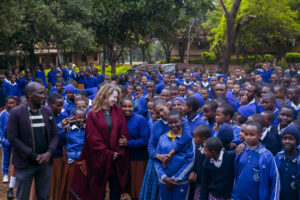
I visited five high schools, speaking with administrators, teachers, students, and alumni to understand firsthand the impact in these two areas.
In the labs, I clearly saw improvements to the educational experience. Teachers were projecting materials for physics and math lessons. Students were researching topics using an online curriculum system. Many students were learning foundational computer skills – word processing, spreadsheets, and presentations. During one session in the Banjika Secondary School lab, I had initially thought that a student named Dora was viewing a website, only to discover that Dora was in the middle of designing and programming the web page herself! It was especially meaningful to see the Computer Studies curriculum in action that I had helped create 30 years ago.
But what about the second goal— improving employability? It wasn’t until I sat down to speak with the students and alumni that I began to fully understand the impact.
One question that I asked students was “Wazazi wako wanafanya kazi gani?” – What do your parents do for work? The first student, Lucy, who studied at Banjika Secondary, answered, “My parents are farmers.” Most students answered that exact same way. I couldn’t help but wonder how many of these students would follow in their parents’ footsteps. In fact, roughly two-thirds of Tanzanians today work in agriculture— mostly in small-scale, rural, subsistence farming.
But when I asked these students what they would like to do for work there was a dramatic shift. Lucy wants to be an “IT expert.” Others spoke about becoming engineers, doctors, and accountants– careers that depend on the very skills they’re learning in these labs.
Speaking with former students made the impact even clearer. One former student, Severin, went on to teach Computer Studies at Welwel Secondary School. Another, Pascal, works as a school teacher at Kainam Secondary School and assists in teaching Computer Studies there. One former student shared that they now work at a shop in town that requires computer skills—something that wouldn’t have been possible without the training they received in the lab. Another pointed out that often even applying for jobs or university now requires digital skills for online applications.
By the end of these conversations, I found myself thinking less about the technology itself and more about the opportunities being enabled. These labs aren’t just providing computers—they’re expanding what students believe is possible for their futures and what they can achieve.
And that may be the most important outcome of all!




No comment yet, add your voice below!