
Why it Works: The Tanzanian Technical Team
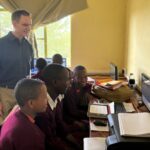
I recently had the opportunity to visit Tanzania to meet the Powering Potential local team and see their work firsthand. This post is part 2 of a 3-part series about my experience.
Last year, I joined the board of Powering Potential Inc. (PPI) whose mission is to use technology to improve education and employment opportunities for Tanzanian high school students.
One of my passions throughout my 30-year Engineering career has been working with teams of engineers to create and enhance products. Until this trip, I had never met the Tanzania-based PPI technical team in person.
So, in February I traveled to Tanzania to meet this team who has been deploying technology into rural high schools for the past 20 years. I wanted to know what their biggest challenges have been and how they overcame them.
In our first meeting they walked me through the evolution of their systems, showing me examples of each. It was like a computer “show and tell” spanning two decades.
What struck me wasn’t the hardware—it was the team’s depth of expertise.
Each design change reflected a real-world challenge. One hardware change was to a more closed form factor in order to improve durability given the often harsh (e.g. dusty!) environmental conditions. Another reduced power consumption to extend usage times on solar-based systems. Yet another was switching from using the open-source Linux operating system to Windows, based on what schools said teachers and students needed most. This is a team that deeply understands its operational environment and continually improves the systems over time.
One of the biggest challenges the team has tackled is electricity for the computer labs. Because these schools are all rural, electricity from the grid is at best intermittent. Oftentimes the lab has no access to the electrical grid at all. To ensure that students at these rural schools can still access the technology and technical training, the PPI team has integrated solar with battery storage into the overall systems they deploy.
The combination of technical expertise and practical problem-solving is what makes these labs work. I came away impressed with the team—not just by what they’ve built, but by how they continually improved the system over time. I look forward to working with them as we solve the next set of challenges to provide technology—and really, to provide opportunity – to students at rural Tanzanian schools.





No comment yet, add your voice below!