New Board Member Visits Tanzania: Why it Matters

Why it Matters: Opportunities and Impact

I recently had the opportunity to visit Tanzania to meet the Powering Potential local team and see their work firsthand. This post is part 3 of a 3-part series about my experience.

As I mentioned in my earlier posts, I joined the board of Powering Potential Inc. (PPI) last year and then recently visited our projects in Tanzania deploying solar-powered computer labs to high schools.

PPI’s mission is to use technology to improve two areas for Tanzanian high school students: (1) their educational experience at the schools and (2) their employability after graduation.

I visited five high schools, speaking with administrators, teachers, students, and alumni to understand firsthand the impact in these two areas.

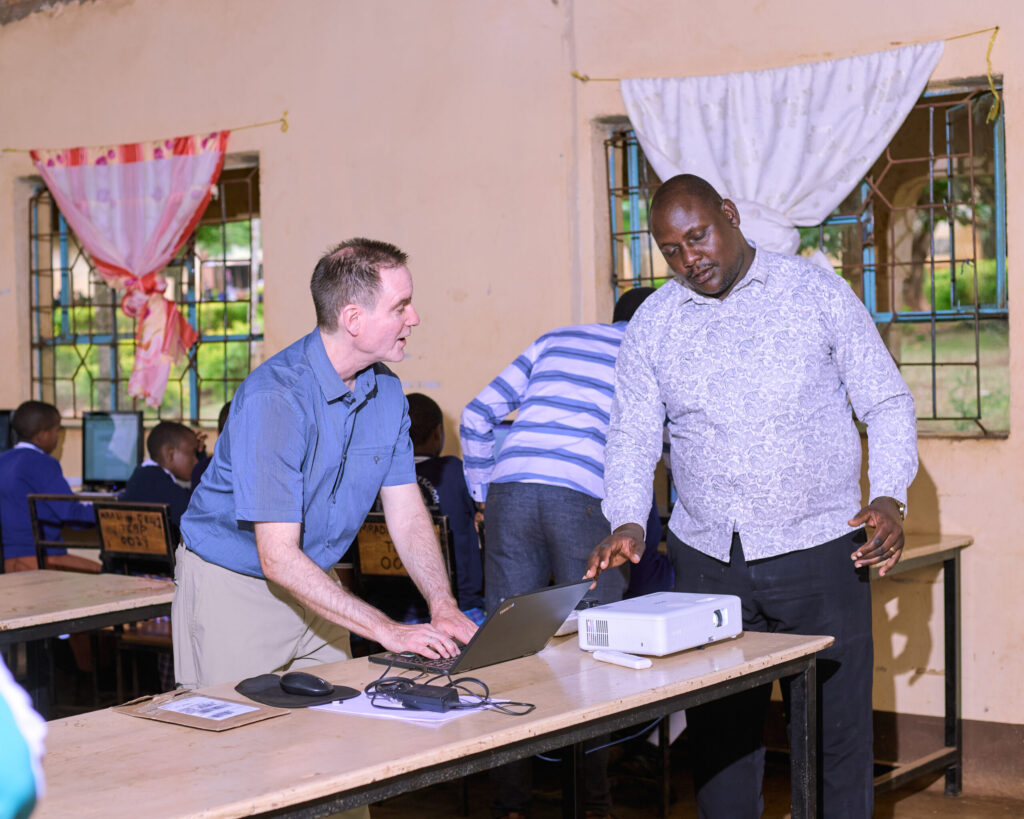
In the labs, I clearly saw improvements to the educational experience. Teachers were projecting materials for physics and math lessons. Students were researching topics using an online curriculum system. Many students were learning foundational computer skills – word processing, spreadsheets, and presentations. During one session in the Banjika Secondary School lab, I had initially thought that a student named Dora was viewing a website, only to discover that Dora was in the middle of designing and programming the web page herself! It was especially meaningful to see the Computer Studies curriculum in action that I had helped create 30 years ago.

But what about the second goal— improving employability? It wasn’t until I sat down to speak with the students and alumni that I began to fully understand the impact.

One question that I asked students was “Wazazi wako wanafanya kazi gani?” – What do your parents do for work? The first student, Lucy, who studied at Banjika Secondary, answered, “My parents are farmers.” Most students answered that exact same way. I couldn’t help but wonder how many of these students would follow in their parents’ footsteps. In fact, roughly two-thirds of Tanzanians today work in agriculture— mostly in small-scale, rural, subsistence farming.

But when I asked these students what they would like to do for work there was a dramatic shift. Lucy wants to be an “IT expert.” Others spoke about becoming engineers, doctors, and accountants– careers that depend on the very skills they’re learning in these labs.

Speaking with former students made the impact even clearer. One former student, Severin, went on to teach Computer Studies at Welwel Secondary School. Another, Pascal, works as a school teacher at Kainam Secondary School and assists in teaching Computer Studies there. One former student shared that they now work at a shop in town that requires computer skills—something that wouldn’t have been possible without the training they received in the lab. Another pointed out that often even applying for jobs or university now requires digital skills for online applications.

By the end of these conversations, I found myself thinking less about the technology itself and more about the opportunities being enabled. These labs aren’t just providing computers—they’re expanding what students believe is possible for their futures and what they can achieve.

And that may be the most important outcome of all!

New Board Member Visits Tanzania: The Tanzanian Technical Team

Why it Works: The Tanzanian Technical Team

I recently had the opportunity to visit Tanzania to meet the Powering Potential local team and see their work firsthand. This post is part 2 of a 3-part series about my experience.

Last year, I joined the board of Powering Potential Inc. (PPI) whose mission is to use technology to improve education and employment opportunities for Tanzanian high school students.

One of my passions throughout my 30-year Engineering career has been working with teams of engineers to create and enhance products. Until this trip, I had never met the Tanzania-based PPI technical team in person.

So, in February I traveled to Tanzania to meet this team who has been deploying technology into rural high schools for the past 20 years. I wanted to know what their biggest challenges have been and how they overcame them. 

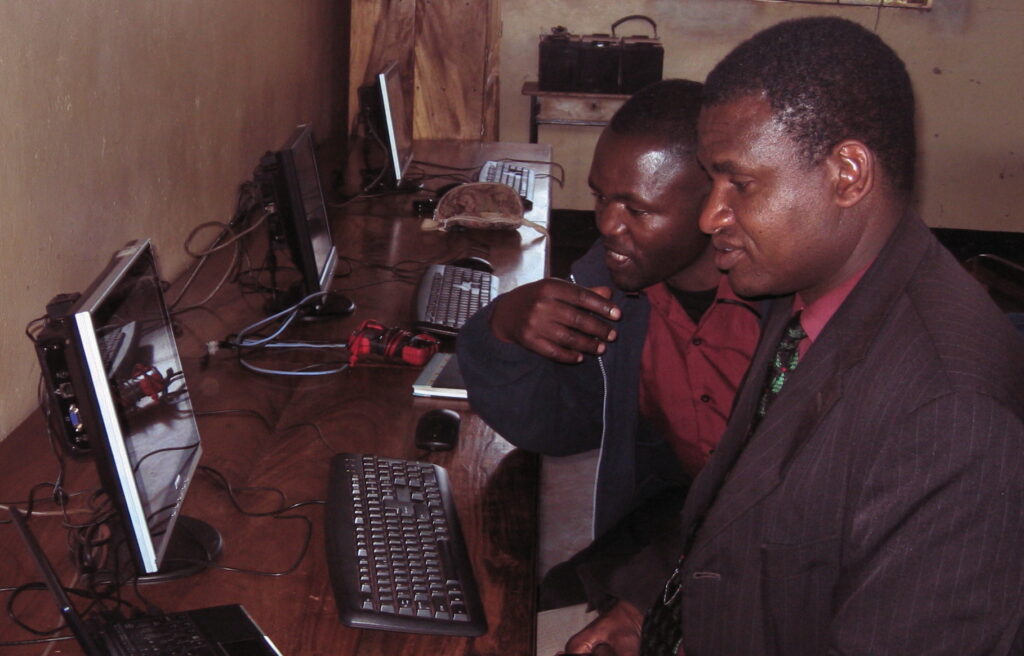
In our first meeting they walked me through the evolution of their systems, showing me examples of each. It was like a computer “show and tell” spanning two decades. 

What struck me wasn’t the hardware—it was the team’s depth of expertise.

Each design change reflected a real-world challenge. One hardware change was to a more closed form factor in order to improve durability given the often harsh (e.g. dusty!) environmental conditions. Another reduced power consumption to extend usage times on solar-based systems. Yet another was switching from using the open-source Linux operating system to Windows, based on what schools said teachers and students needed most. This is a team that deeply understands its operational environment and continually improves the systems over time.

One of the biggest challenges the team has tackled is electricity for the computer labs. Because these schools are all rural, electricity from the grid is at best intermittent. Oftentimes the lab has no access to the electrical grid at all. To ensure that students at these rural schools can still access the technology and technical training, the PPI team has integrated solar with battery storage into the overall systems they deploy.

The combination of technical expertise and practical problem-solving is what makes these labs work. I came away impressed with the team—not just by what they’ve built, but by how they continually improved the system over time. I look forward to working with them as we solve the next set of challenges to provide technology—and really, to provide opportunity – to students at rural Tanzanian schools.

New Board Member Visits Tanzania: The Biggest Challenge

The Biggest Challenge

Hi, I’m AJ! I joined the board of Powering Potential last year and recently had the opportunity to visit Tanzania to meet the Powering Potential local team and see their work firsthand. This post is part 1 of a 3-part series about my experience.

For two years in the mid-1990’s, I lived in a rural village in Tanzania as a Peace Corps high school math teacher, teaching subjects from algebra through calculus. It was an eye-opening experience—both culturally and professionally.

During that time, I also worked with the Tanzanian government to co-author the national curriculum for Computer Studies for high schools. While almost no high schools had computers at the time, the curriculum laid the groundwork for educating students in the distant future.

Fast-forward 30 years.

Today, I serve on the board of Powering Potential Inc. (PPI), which provides solar-powered computer labs and digital skills training to rural secondary schools in Tanzania. PPI’s mission is to use technology to improve education and expand employment opportunities for high school students.

In February, I visited five Tanzanian high schools with active PPI computer lab projects. Many people asked me the same question: “What is the biggest change you see in these rural schools after 30 years??”

I confess I struggled initially with the question.

It’s easy to see developmental changes in the nearby towns- more buildings, more cars, more businesses, and of course, the proliferation of cell phone usage. But what about rural high schools? So many things seemed exactly the same. The winding dirt roads leading up to the schools, the eager students lining up in their colorful uniforms, the teachers at the front of classrooms conveying lessons… It all seemed the same.

Then it hit me! The biggest change at these schools was precisely why I was there: Technology – the computer labs and the opportunities that come with them. 

Now, teachers are projecting videos and other online content to enhance lessons. Students are accessing digital content to supplement their learning. Students are gaining computer skills that open up job opportunities. And the students are studying the very Computer Studies curriculum that I helped shape three decades ago!

These are the biggest changes that I saw in my visit to the rural high schools —and they are all for the better.

Listening In From Tanzania: What We Learned At Our Latest Lunch & Learn

Earlier this month, Powering Potential donors and friends joined us for a virtual Lunch & Learn to hear directly from our Tanzanian team and teachers at partner schools. We’ve already shared some of the key takeaways by email and on social media, but the conversation itself was rich enough that it deserves a home on our blog.

Lunch & Learns give our community a chance to hear unfiltered stories from the people who are using our computer labs every day. Donors see how their support shows up in real classrooms, and teachers and students get to speak directly to the people investing in their futures.

These conversations also help us bridge the gap between rural Tanzanian schools and supporters around the world. When donors hear teachers describe crowded classrooms, long travel times, and the realities of teaching without reliable electricity, the impact of a solar‑powered computer lab becomes much more concrete.

We are so excited to use the online teaching materials from the Tanzanian Ministry of Education. The computers have helped the teachers and students 100%.”

– Diego teacher Pascal Lucas.

What Teachers Shared

During the call, several teachers described how access to computers, projectors, and digital curriculum has changed their teaching and their students’ lives:

Alumni Success & Full-Circle Story

Justine Temu from Banjika Secondary School talked about graduates who’ve found success, both in university and in securing jobs because of their computer skills training. Justine himself learned computer skills on the first computers donated to Banjika 20 years ago.

Digital Tools Driving Better Outcomes

Eligi Tairo shared how teachers are embracing new teaching methods with digital tools, leading to stronger learning. As they gain confidence with laptops, projectors, and digital curriculum, teachers are also growing professionally and finding new ways and learning styles to reach students .

Students & Small Businesses

Eligi also highlighted how students are using their digital skills beyond the classroom. Graduates are drawing on what they learned in the lab to become entrepreneurs, designing flyers, using social media, and marketing their own.

Technology Improving Focus & Performance

Teachers shared recurring themes: when teachers use projectors, students pay more attention; digital tools help teachers cover the syllabus on time; and students are better prepared for national exams. 

As these benefits extend beyond the classroom, digital skills are becoming essential not only for passing exams but also for helping students find work and participate in the local and global economy.

Everyday Challenges, Real‑World Solutions

One story that stuck with many of us was about something as simple as printing exams. Before Banjika had computers and a printer, staff had to drive roughly two hours into town and pay someone to type and print tests or forms – trips that could take an entire day during the rainy season, when roads are muddy. 

Now, teachers can prepare and print what they need at school, saving both money and countless hours!

Over the past 20 years, we’ve updated our technology and solar systems based on feedback from the schools. Conversations like this Lunch & Learn help ensure that our projects keep pace with changing conditions on the ground, so we continue to meet the needs of the people we are working to help.

Thank You To Our Community

We are deeply grateful to everyone who joined us, asked thoughtful questions, and listened to our partners’ stories. Your curiosity and encouragement mean a great deal to our team and to the students and teachers we serve!

Please consider sharing this blog post or social posts.